

ALBANY, N.Y., (May 7, 2012) – Momentive Performance Materials Inc. (“Momentive Performance Materials” or the “Company”) today reported its consolidated results for the first quarter ended March 31, 2012. Results for the first quarter of 2012 include:
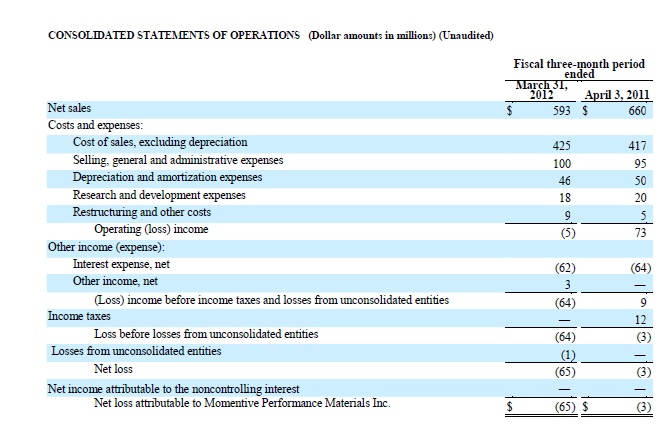
· Net sales of $593 million compared to $660 million in the three-month period ended March 31,2011 a decrease of 10 percent. The decline was primarily due to a decrease in volume and price,as well as a shift in product mix.
· Operating loss of $(5) million versus operating income of $73 million in the three-month periodended April 3, 2011. First quarter 2012 operating loss reflected raw material inflation, lowervolumes from softer global demand and product mix shift due to declines in certain higher margin products.
· Net loss attributable to Momentive Performance Materials Inc. of $(65) million compared to a net loss of $(3) million in the three-month period ended April 3, 2011, which reflected the same factors impacting operating loss.
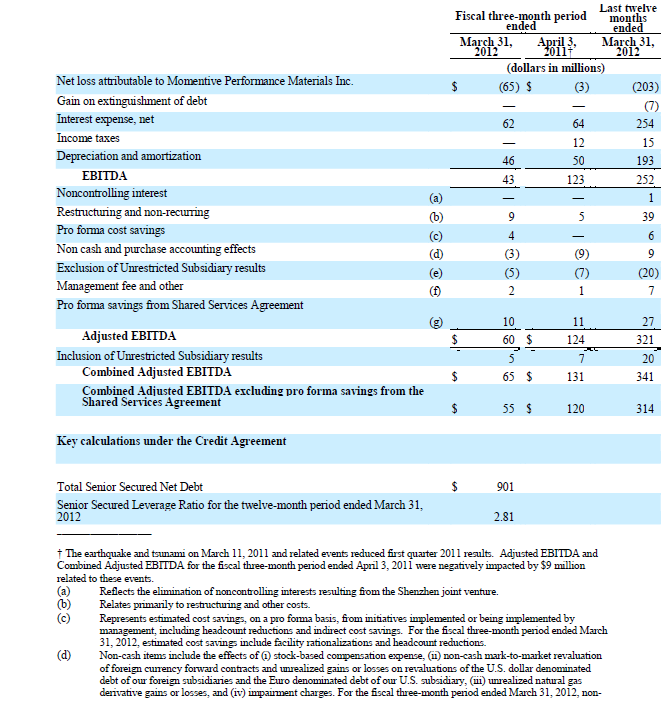
· Combined Adjusted EBITDA, excluding the impact of pro forma cost savings from the shared services agreement, of $55 million in the three-month period ended March 31, 2012 compared to $120 million in the three-month period ended April 3, 2011. Combined Adjusted EBITDA is a non-GAAP financial measure and is defined and reconciled to Net Income (Loss) later in this release.
“While we experienced lower volumes and Adjusted EBITDA in the first quarter of 2012 compared to the prior year, our sequential quarterly improvement demonstrates the beginning of a rebound from the lows of the fourth quarter,” said Craig O. Morrison, Chairman, President and CEO. “Our first quarter 2012 results reflected a shift in product mix as we continued to experience softer demand for higher-margin products in the Asia Pacific region, as well as declines in our quartz earnings.”
“In response, we have further enhanced our focus on reducing our cost structure, including steadily achieving savings from the shared services agreement with Momentive Specialty Chemicals Inc. (MSC).
In the first quarter of 2012, we achieved $7 million in savings under the shared services agreement with MSC and we have realized approximately $47 million in synergy savings on a run-rate basis since the program began in late 2010. Beyond the cost saving initiatives with MSC, plans are in process for additional restructuring programs to further enhance our cost structure and better serve our customers.”
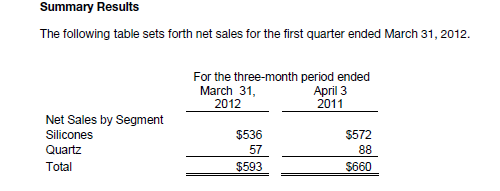
Net sales in the three-month period ended March 31, 2012 were $593 million, compared to $660 million for the three-month period ended April 3, 2011, a decrease of 10 percent. The decrease was primarily due to a decrease in price and mix shift of $49 million and volume of $17 million.
Net sales for the Silicones segment in the three-month period ended March 31, 2012 were $536 million,compared to $572 million for the quarter-ended March 31, 2011, a decrease of 6 percent. The decreasewas primarily due to a decrease in price and mix shift of $49 million, partially offset by an increase in volume of $14 million.
Net sales for the Quartz segment in the three-month period ended March 31, 2012 were $57 million,compared to $88 million for the three-month period ended April 3, 2011, a decrease of 35 percent. The decrease was due to lower volumes reflecting a downturn in demand for semiconductor capital goods.
Outlook
“As previously disclosed, we continued to see sequential improvement in our average daily order rate for our silicone products through March 2012 versus year-end 2011 levels,” Morrison said. “We believe that over time we will return to margins more in line with our historical results and that we are well-positioned for the long-term as we take actions to align our business for a gradual recovery that is expected to occur in 2012.”
“In addition to our focus on productivity, we remain committed to investing in the long-term growth of our specialty materials platform globally. We recently announced an additional investment in our Chennai, India site, completed our quartz expansion at our Newark, Ohio site and our other quartz expansion projects remain on track. Integration of a number of global Momentive Performance Materials and MSC research and development sites continues in an effort to accelerate our new product development pipeline, which we expect to help drive future growth.”
Refinancing Activities
In April 2012, Momentive Performance Materials incurred incremental term loans due May 2015 under its senior secured credit facilities in an aggregate principal amount of $175 million. Net consideration from the transaction (which consisted of a combination of cash and rollover debt after discounts and fees), together with cash on hand, was used to extinguish approximately $178 million of existing term loans maturing December 2013, effectively extending the Company’s debt maturity profile. The refinancing was executed by the Company’s wholly owned subsidiary Momentive Performance Materials GmbH, the German Borrower under its senior secured credit facilities.
Liquidity and Capital Resources
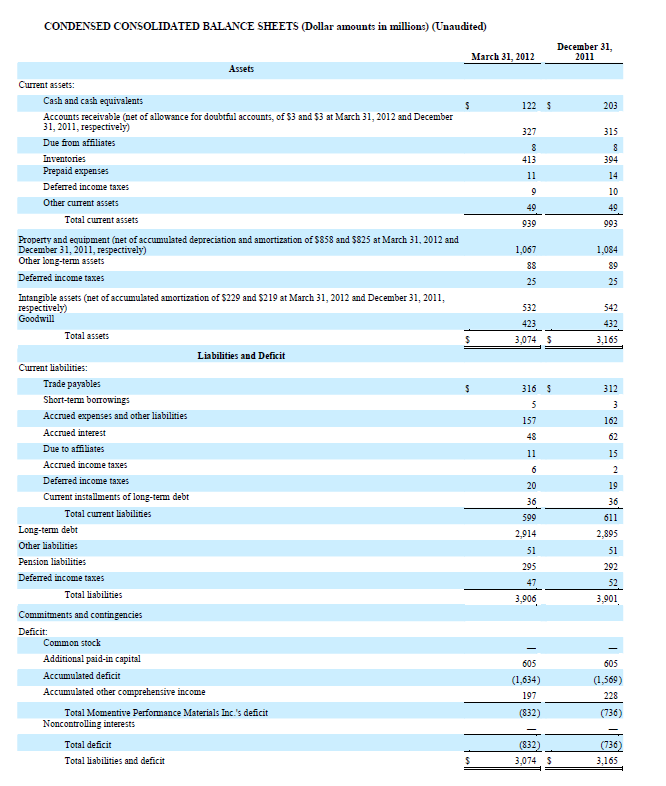
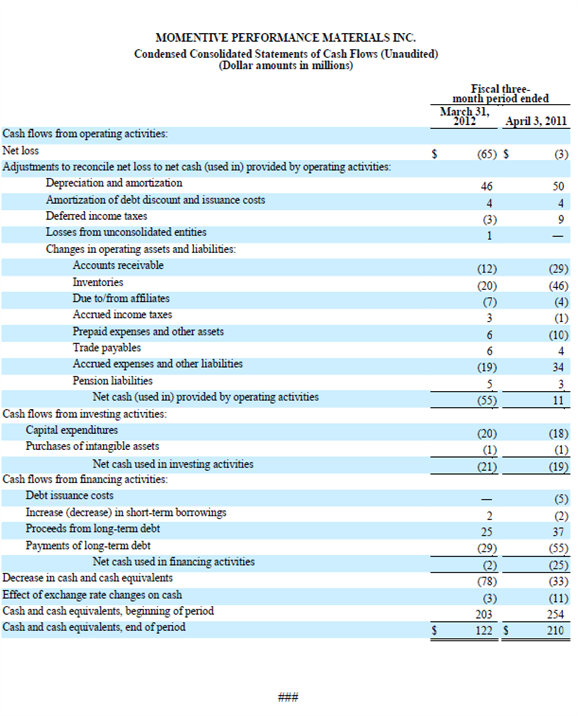
At March 31, 2012, Momentive Performance Materials had $3.0 billion of long-term debt compared to $2.9 billion of long-term debt at December 31, 2011. In addition, at March 31, 2012, Momentive Performance Materials had $378 million in liquidity including $122 million of cash and cash equivalents and $256 million of borrowings available under our senior secured revolving credit facility.
At March 31, 2012, the Company was in compliance with all financial covenants that govern its senior secured credit facilities, including its senior secured debt to Adjusted EBITDA ratio. Based on Momentive Performance Materials’ current assessment of its operating plan and the general economic outlook, the Company believes that its cash flow from operations and available cash, including available borrowings under its senior secured credit facilities, will be adequate to meet its liquidity needs for the foreseeable future.
Earnings Call
Momentive Performance Materials will host a teleconference to discuss first quarter ended 2012 results on Monday, May 7, 2012, at 10 a.m. Eastern Time. Interested parties are asked to dial-in approximately 10 minutes before the call begins at the following numbers:
U.S. Participants: 866-770-7051
International Participants: 617-213-8064
Participant Passcode: 13829105
Live internet access to the call and presentation materials will be available through the Investor Relations section of the Company’s website: www.momentive.com. A replay of the call will be available for three weeks beginning at 1 p.m. Eastern Time on May 7, 2012. The playback can be accessed by dialing 888-286-8010 (U.S.) and +1-617-801-6888 (International). The passcode is 77420174. A replay also will be available through the Investor Relations Section of the Company’s website.
Covenants under our Senior Secured Credit Facility and the Notes
The credit agreement governing our senior secured credit facilities and the indentures governing the notes contain various covenants that limit our ability to, among other things:
- incur or guarantee additional debt;
- pay dividends and make other distributions to our stockholders;
- create or incur certain liens;
- make certain loans, acquisitions, capital expenditures or investments;
- engage in sales of assets and subsidiary stock;
- enter into sale/leaseback transactions;
- enter into transactions with affiliates; and
- transfer all or substantially all of our assets or enter into merger or consolidation transactions.
In addition, at any time that loans or letters of credit are outstanding (and not cash collateralized) thereunder, our revolving credit facility (which is part of our senior secured credit facilities) requires us to maintain a specified net first-lien indebtedness to Adjusted EBITDA ratio, referred to as the “Senior Secured Leverage Ratio”. Specifically, the ratio of our “Total Senior Secured Net Debt” (as defined in the credit agreement governing the senior secured credit facilities) to trailing twelve-month Adjusted EBITDA (as adjusted per the credit agreement governing the senior secured credit facilities) may not exceed 4.25 to 1 as of the last day of any fiscal quarter. In addition, our ability to incur indebtedness or make investments is restricted under the indentures governing our notes unless we have an Adjusted EBITDA to fixed charges ratio (measured on a last twelve months basis) of at least 2.00 to 1.00. “Fixed charges” are defined under the indentures as net interest expense, excluding the amortization or write-off of deferred financing costs. As of March 31, 2012, we were not able to satisfy this test. The restrictions on our ability to incur indebtedness or make investments under the indentures, however, are subject to exceptions, including exceptions that permit indebtedness under our senior secured credit facilities. On March 31, 2012, we were in compliance with the senior secured leverage ratio maintenance covenant, the other covenants under the credit agreement governing the senior secured credit facilities and the covenants under the indentures governing the notes.
Reconciliation of Financial Measures that Supplement U.S. GAAP
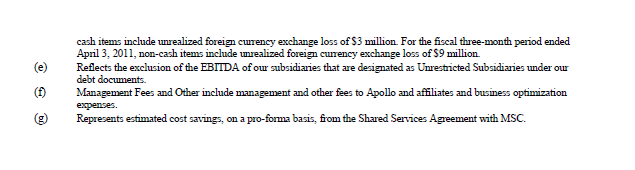
EBITDA consists of earnings before interest, taxes and depreciation and amortization. EBITDA is a measure commonly used in our industry and we present EBITDA to enhance your understanding of our operating performance. We use EBITDA as one criterion for evaluating our performance relative to that of our peers. We believe that EBITDA is an operating performance measure, and not a liquidity measure, that provides investors and analysts with a measure of operating results unaffected by differences in capital structures, capital investment cycles and ages of related assets among otherwise comparable companies. Adjusted EBITDA is defined as EBITDA further adjusted for unusual items and other pro forma adjustments permitted in calculating covenant compliance in the credit agreement governing our credit facilities and indentures governing the notes to test the permissibility of certain types of transactions. Adjusted EBITDA as presented in the table below corresponds to the definition of “EBITDA” calculated on a “Pro Forma Basis” used in the credit agreement and substantially conforms to the definition of “EBITDA” calculated on a pro forma basis used in the indentures. Adjusted EBITDA has important limitations as an analytical tool, and you should not consider it in isolation, or as a substitute for analysis of our results as reported under U.S. GAAP. For example, Adjusted EBITDA does not reflect:
(a) our capital expenditures, future requirements for capital expenditures or contractual commitments;
(b) changes in, or cash requirements for, our working capital needs;
(c) the significant interest expenses, or the cash requirements necessary to service interest or principal payments, on our debt;
(d) tax payments that represent a reduction in cash available to us;
(e) any cash requirements for the assets being depreciated and amortized that may have to be replaced in the future;
(f) management fees that may be paid to Apollo;
or (g) the impact of earnings or charges resulting from matters that we and the lenders under our secured senior credit facilities may not consider indicative of our ongoing operations.
In particular, our definition of Adjusted EBITDA allows us to add back certain non-cash, non-operating or non-recurring charges that are deducted in calculating net income, even though these are expenses that may recur, vary greatly and are difficult to predict and can represent the effect of long-term strategies as opposed to short-term results. In addition, certain of these expenses can represent the reduction of cash that could be used for other corporate purposes. Further, as included in the calculation of Adjusted EBITDA below, the measure allows us to add estimated cost savings and operating synergies related to operational changes ranging from restructuring to acquisitions to dispositions as if such event occurred on the first day of the four consecutive fiscal quarter period ended on or before the occurrence of such event and/or exclude one-time transition expenditures that we anticipate we will need to incur to realize cost savings before such savings have occurred. Adjusted EBITDA excludes the EBITDA of our subsidiaries that are designated as Unrestricted Subsidiaries under our debt documents. We define Combined Adjusted EBITDA as Adjusted EBITDA modified to include the EBITDA of our subsidiaries that are designated as Unrestricted Subsidiaries under our debt documents. Combined Adjusted EBITDA is an important performance measure used by our senior management and the board of directors to evaluate operating results and allocate capital resources. EBITDA, Adjusted EBITDA and Combined Adjusted EBITDA are not measurements of financial performance under U.S. GAAP, and our EBITDA, Adjusted EBITDA and Combined Adjusted EBITDA may not be comparable to similarly titled measures of other companies. You should not consider our EBITDA, Adjusted EBITDA or Combined Adjusted EBITDA, which are non-U.S. GAAP financial measures, as an alternative to operating or net income, determined in accordance with U.S. GAAP, as an indicator of our operating performance, or as an alternative to cash flows from operating activities, determined in accordance with U.S. GAAP, as an indicator of our cash flows or as a measure of liquidity. The following table reconciles net loss attributable to Momentive Performance Materials Inc. to EBITDA, Adjusted EBITDA (as calculated under our credit agreement and as substantially calculated under our indentures) and Combined Adjusted EBITDA for the periods presented: